Health & Wellness Guide
How Walking After Meals Supports Blood Sugar
A look at what happens in the body after eating, and why a gentle stroll may help keep glucose levels steadier.
For many people, the stretch of time after a meal is when blood sugar climbs the highest, and it is also a moment when most of us settle onto the couch or return to a desk. Walking after meals is a simple habit that researchers and health organizations have increasingly examined as a way to support blood sugar control. The idea is straightforward: when muscles are active, they draw glucose out of the bloodstream, which may blunt the rise that follows eating. This article explains what happens in the body after a meal, how walking changes that process, what the research broadly suggests, and where the limits of the evidence lie, so that you can decide whether a short post-meal walk fits your life.
What Happens to Blood Sugar After You Eat
When you eat food that contains carbohydrates, your digestive system breaks it down into simple sugars, chiefly glucose, which enter the bloodstream. As blood glucose rises, the pancreas releases insulin, a hormone that helps cells absorb glucose for energy or storage. In a person without diabetes, this system usually brings blood glucose back toward its baseline within a few hours.
In people with type 2 diabetes or prediabetes, the process works less efficiently. Cells may respond poorly to insulin, a condition known as insulin resistance, or the body may not produce enough insulin to meet demand. As a result, blood glucose after meals, often called postprandial glucose, can rise higher and remain elevated longer. Major health bodies, including the American Diabetes Association, recognize that managing these post-meal rises is one part of overall glucose management, alongside diet, medication where prescribed, sleep, and physical activity.
How Muscles Use Glucose When You Walk

Skeletal muscle is one of the body’s largest consumers of glucose. When muscles contract during activity, they can take up glucose from the blood through pathways that do not depend entirely on insulin. Physiology research has long described how contraction prompts glucose transporters, notably GLUT4, to move to the surface of muscle cells, allowing glucose to enter. This is a central reason exercise is recognized as a useful tool for people with insulin resistance.
Timing matters because the glucose from a meal is arriving in the bloodstream at the same moment your muscles are working. Rather than waiting for insulin alone to clear the surge, active muscles add a second route for glucose removal. Walking is a low-intensity activity, so it relies largely on this mechanism without the physical strain of more vigorous exercise, which is part of why it is so widely recommended as an accessible starting point.
Context box: the basic mechanism
Eating raises blood glucose. Insulin helps cells absorb it. Muscle contraction during walking offers an additional way for glucose to leave the blood. Together, the two routes may reduce how high and how long glucose stays elevated after a meal.
What Research Says About Post-Meal Walking and Glucose Control
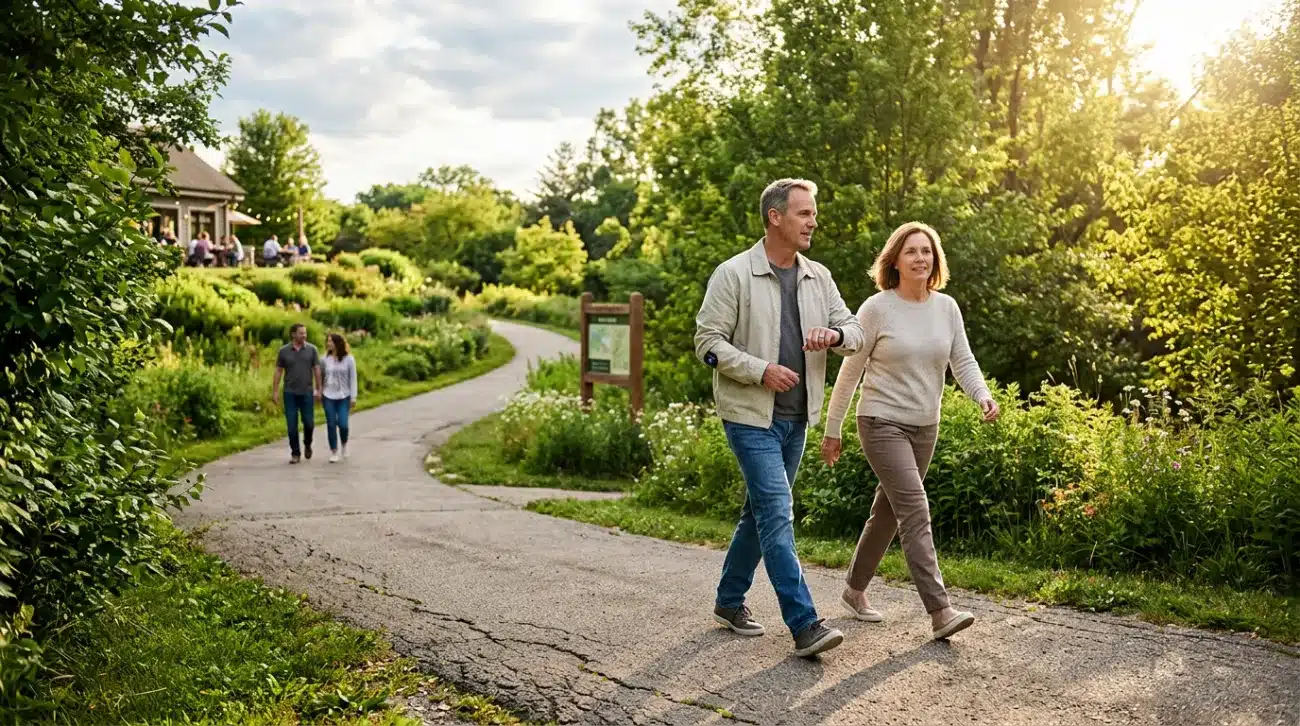
Several small clinical studies and reviews of the research have compared walking soon after eating with sitting or with walking at other times of day. Their general finding is that light activity after a meal tends to lower post-meal glucose readings compared with remaining seated, and that the effect appears in both people with type 2 diabetes and people without it. Some studies have suggested that a short walk after a meal may be at least as effective for the post-meal glucose response as one longer walk taken at a different time, though results vary between studies.
It is important to read these findings with care. Many of the trials are small, short in duration, and conducted under controlled conditions that differ from everyday life. Meals differ in composition, participants differ in age, fitness, and medication use, and researchers measure outcomes in different ways. The research supports the idea that post-meal walking is a promising and low-risk habit, but it does not show that it replaces other treatment, and it does not guarantee a specific reduction for any individual.
Broader guidance points in the same direction. The American Diabetes Association and other public health bodies encourage adults to be physically active and to avoid long uninterrupted periods of sitting, suggesting brief bouts of light activity to break them up. Post-meal walking fits naturally within that advice.
Timing, Duration and Pace of a Post-Meal Walk

Studies examining post-meal walking have typically used short sessions, often in the range of ten to fifteen minutes, begun shortly after finishing a meal. The reasoning is that blood glucose generally rises in the period following eating, so activity during that window may have the greatest chance of influencing the peak. There is no single universally agreed protocol, and the exact best timing may differ from person to person and from meal to meal.
Pace also does not need to be demanding. A comfortable walk at a pace where you can still hold a conversation is the type of light activity most often studied. Some people find that walking immediately after a large meal causes discomfort, in which case a short wait or a slower pace is a reasonable adjustment. Consistency probably matters more than perfection, since a habit that you can maintain after most meals is more practical than an ideal routine you abandon within a week.
Contextual breakdown: a simple way to think about the walk
Editorial categorization, not measured data.
Starting
Begin soon after finishing the meal, at an easy pace that feels comfortable on a full stomach.
Sustaining
Keep a steady, conversational pace for a short period rather than pushing for intensity.
Repeating
Aim to make it a regular habit, adapting to your schedule, weather, and how you feel.